
Earlier this month, Ontario’s Energy Minister Stephen Lecce announced plans to build a new transmission line under Lake Ontario to bring more electricity to downtown Toronto.
Under his government’s plan, this line will make Toronto reliant on high-cost, first-of-their-kind new American-designed nuclear reactors, which will require us to import enriched uranium from the US to fuel them.
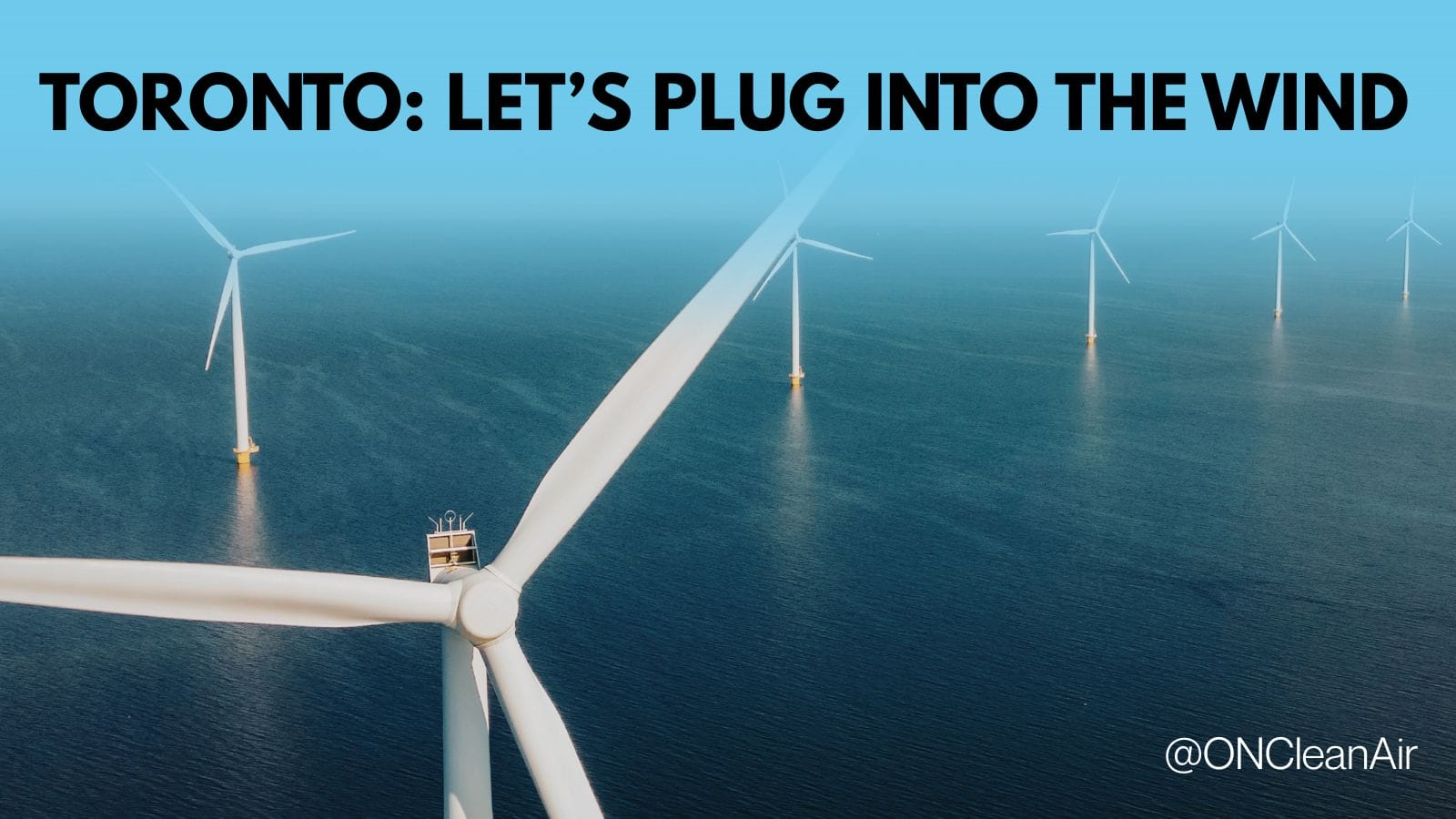
Instead of making our city a guinea pig in a risky, radioactive power experiment, we could instead use this line to support the development of an offshore wind farm in Lake Ontario.
For example, Toronto Hydro could take the lead in building a 130 turbine offshore wind farm, with a lake bed footprint of just 0.013 km2, to supply as much energy as the Portlands gas plant. It could keep our lights on at less than half the cost of new U.S. nuclear reactors.
We are already seeing big jumps in the cost of power thanks to the Ford government’s bet on high cost nuclear reactors. This will only get worse if Ontario spends tens of billions of dollars on reactors that have never been built anywhere before.
Offshore wind is a huge opportunity to supply our city with renewable electricity while also improving air quality and reducing climate damage. It’s also an opportunity to develop jobs and new expertise in an industry that is still growing worldwide – unlike the global nuclear industry which is in decline.
That’s why the federal Major Projects Office and the Canada Infrastructure Bank should be backing offshore wind – not U.S. nuclear reactors at Darlington.
We need Mayor Chow and Toronto City Council to take the reins and work with municipally owned Toronto Hydro to make the most of the strong steady winds blowing across the lake.
What you can do
Please ask Mayor Chow and Toronto City Council to direct Toronto Hydro to work with the Government of Canada’s Major Projects Office, the Canada Infrastructure Bank and the Province of Ontario to expedite the approval, financing and construction of a municipally owned Lake Ontario wind farm ready to supply power by 2030.