
First the good news.
Last week, Toronto City Council’s Infrastructure & Environment Committee approved Councillor Dianne Saxe’s motions requesting city staff to:
- Develop a plan to increase participation in the Peak Perks program to 90% by January 1, 2030; and
- Advise the Electrical Safety Authority that certified plug-in balcony solar units would help the City achieve its climate and affordability goals.
But we can do more.
The Committee didn’t establish targets and timelines to increase Toronto’s supply of local renewable energy, which is unfortunate since more local renewable energy generation will provide multiple benefits for Toronto:
- Reduced pollution from the City’s #1 smog and climate polluter – the Portlands gas plant on Toronto’s waterfront;
- Reduced outflow of Toronto dollars to purchase fossil gas – more than 70% of our gas is imported from the USA;
- Increased energy security;
- More good jobs in Toronto; and
- Lower electricity bills since wind and solar can keep our lights on at a much lower cost than new nuclear reactors.
This was a huge missed opportunity for our City. According to The Atmospheric Fund (TAF), provincial and federal programs are now offering unprecedented levels of funding to support local renewables – “funding that could amount to well into the billions of dollars for Toronto over the next five years based on its population share.”
According to TAF: “Securing that capital depends on well-designed City and Toronto Hydro programs, which will draw new capital into local infrastructure, clean technology deployment, and job creation.”
What you can do
The next meeting of Toronto City Council is on Wednesday, April 22nd.
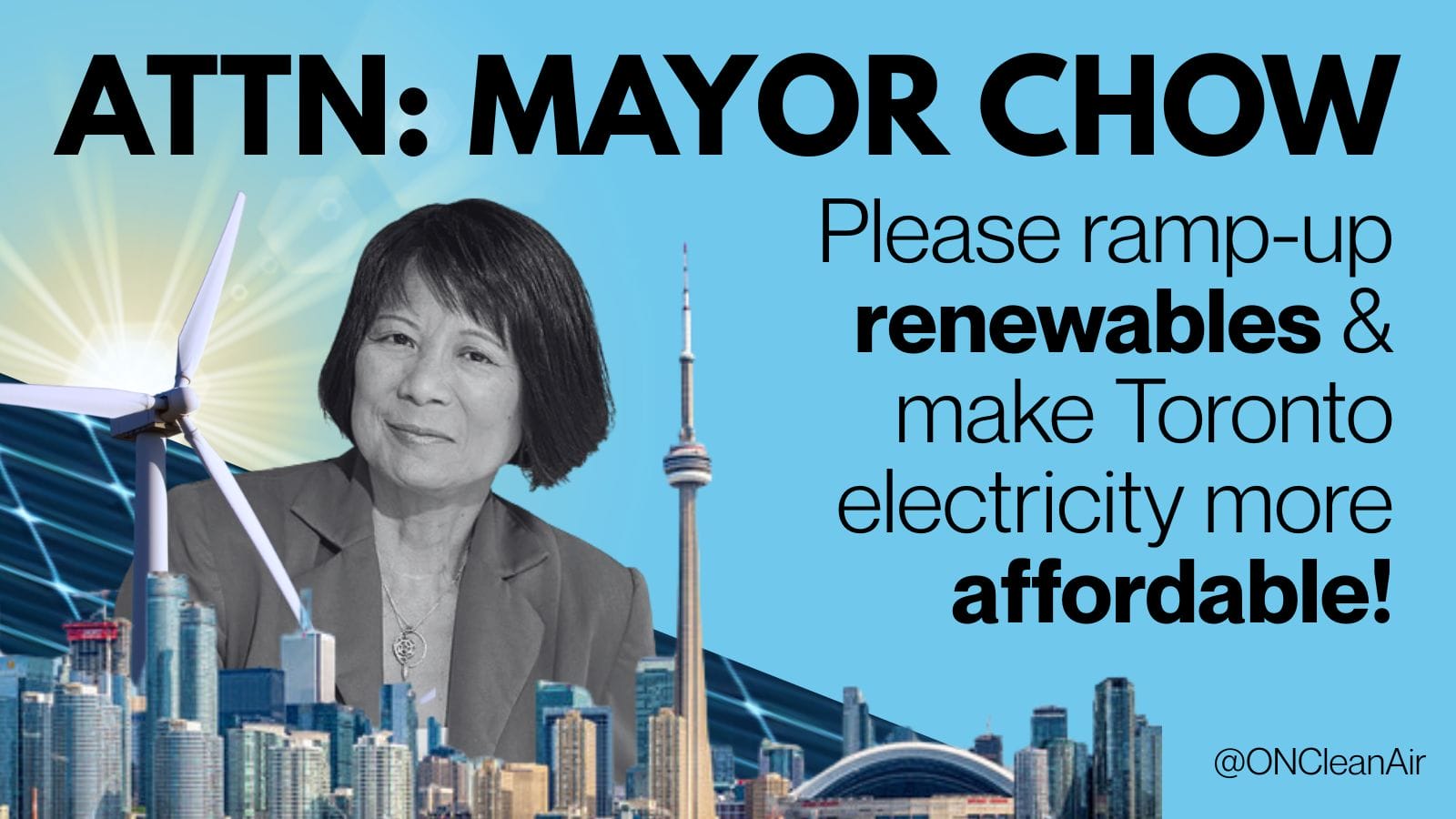
Please ask Mayor Chow and your local councillor to protect Toronto and make electricity more affordable by taking the following actions:
- Ramp up local solar: Direct City Staff and Toronto Hydro to develop and implement plans to increase solar generation by 2.8 billion kWh per year (the equivalent of what the Portlands gas plant produced in 2024) by January 2030 by installing more solar panels on City-owned buildings and parking lots and by encouraging local residents, big box stores and other commercial and industrial companies to install solar.
- Unlock offshore wind power in Lake Ontario. Direct Toronto Hydro to complete by December 2026 a preliminary feasibility study on the potential locations (near shore and far offshore) and costs and benefits of a Lake Ontario offshore wind farm.