
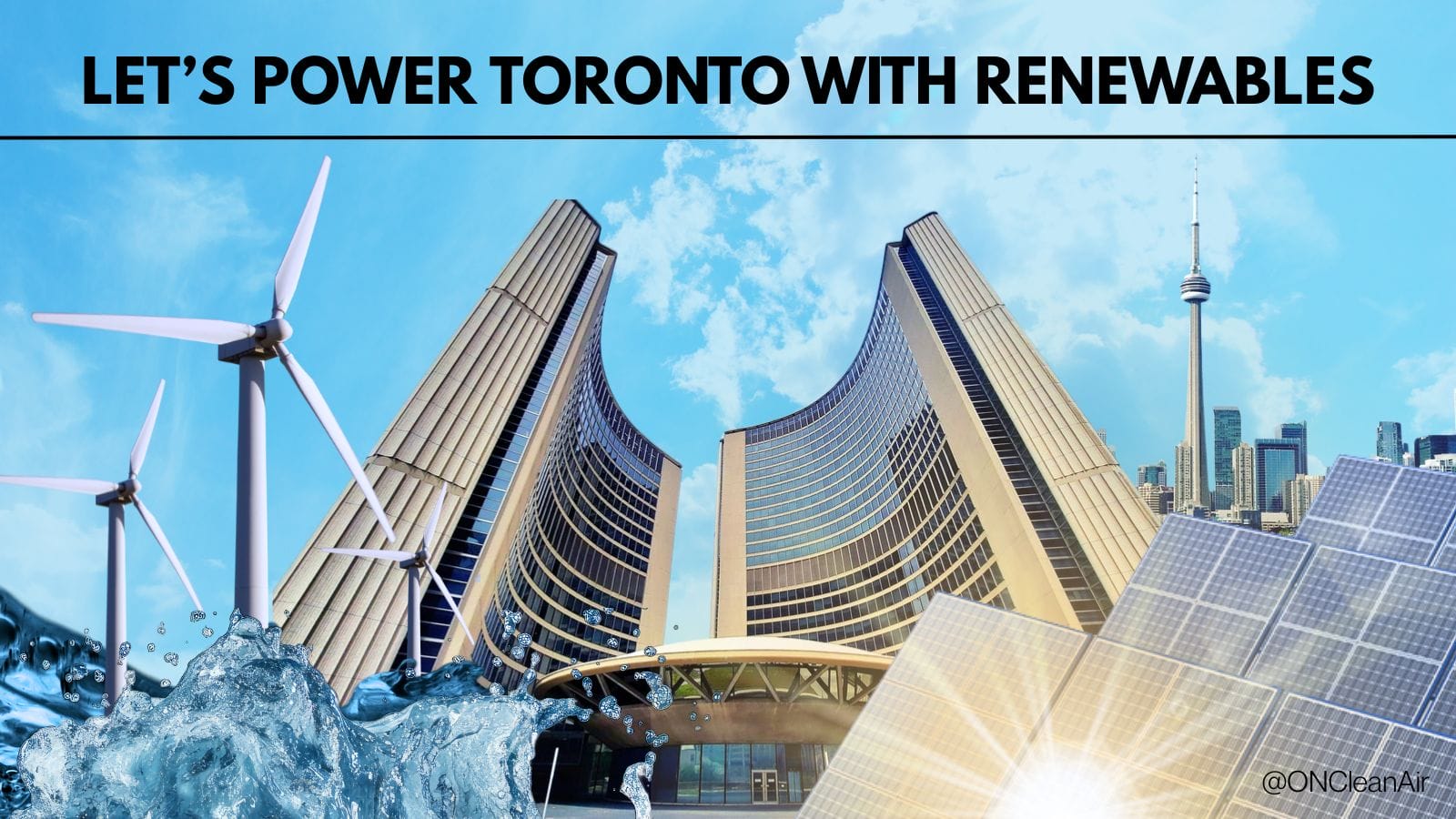
Last week, the City of Toronto’s Department of Environment, Climate and Forestry released its report, The Electrification Advantage, outlining practical, cost-effective actions the City can take to reduce gas burning at the Portlands electricity generating station on Toronto’s waterfront.
This matters because the Portlands gas plant is Toronto’s largest single source of climate pollution and smog.
The report’s recommendations include real solutions within reach:
- Increasing participation in the Peak Perks program, which turns down the thermostats of residential and small business air-conditioners and heat pumps for short periods on hot summer days;
- Accelerate the deployment of solar energy on City-owned buildings and parking lots; and
- Exploring offshore wind power in Lake Ontario.
These are exactly the kinds of solutions Toronto needs. But without clear targets and timelines, they risk being ideas instead of action. If we’re serious about reducing electricity bills and protecting public health, the report must include measurable goals.
On April 7th, we will be asking the City of Toronto’s Infrastructure and Environment Committee to take these next steps:
1. Scale Peak Perks: Direct City Staff to develop and implement a plan to increase Peak Perks market share among Toronto’s residential and small business customers to 90% by Jan. 1, 2030.
Today, only about 10% of single-family homes with central air and/or a heat pump are enrolled in Peak Perks – leaving a massive, low-cost solution largely untapped.
Peak Perks can significantly reduce the need to fire up the Portlands gas plant on the hottest days, with minimal impact on comfort (a maximum two-degree adjustment for no more than three hours).
2. Ramp up local solar: Direct City Staff to develop and implement a plan to increase solar generation by 2.8 billion kWh per year by Jan. 1, 2030 (the equivalent of what the Portlands gas plant produced in 2024,) by installing more solar panels on City-owned buildings and parking lots and by encouraging residents, big box stores and other commercial and industrial companies to install solar on their roofs, balconies and parking lots.
In addition to producing electricity, parking lot solar canopies can reduce heat radiating from asphalt surfaces, shelter vehicles from sun and snow, and provide renewable electricity to charge EVs.
3. Unlock Offshore Wind Power in Lake Ontario: Request Toronto Hydro to complete by December 2026 a preliminary feasibility study on potential locations and costs and benefits of a Lake Ontario offshore wind farm.
Winds across the lake are stronger and steadier than winds across land, and the lakebed footprint of a wind farm capable of providing the same power as Portlands would be only about 0.013 square km. If it were located 10-15 km. offshore it would be barely visible from land.
Together, these solutions make it entirely possible to phase-out the Portlands gas plant.
What you can do
1. Send a message to Mayor Chow and members of the Infrastructure and Environment Committee supporting these recommendations.
2. Request to speak to the Committee on April 7th.